
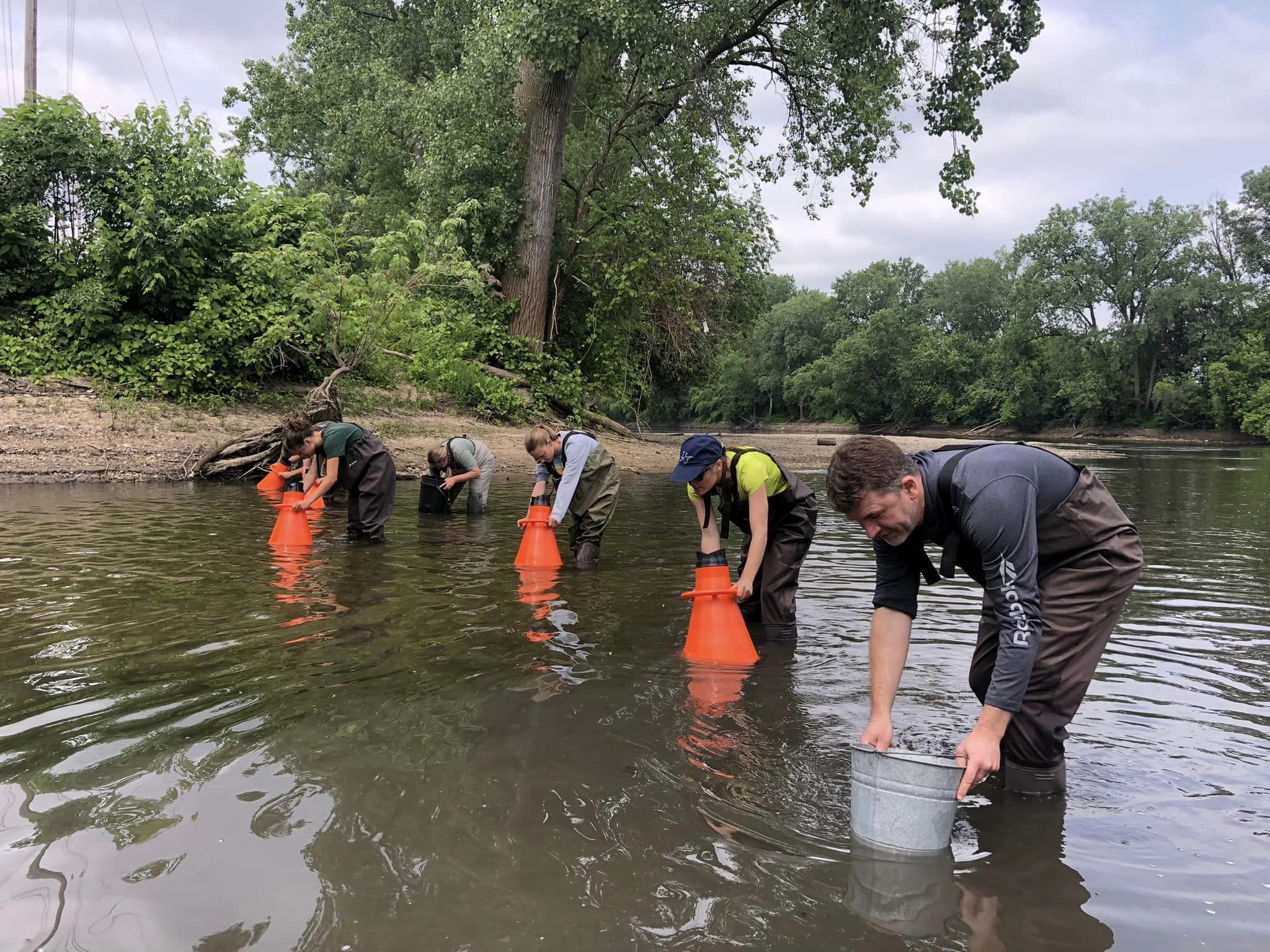
The first official search for mussels in Kent County’s Plaster Creek found seven living species and shells from four other species. The discoveries will help lead to improving the health of the creek.
The survey was launched last summer by a team from the Michigan Department of Environment, Great Lakes, and Energy (EGLE) staff, Calvin University faculty, Plaster Creek Steward (PCS) staff, and student researchers.
Native freshwater mussels live in lakes and streams and play an important role by providing ecosystem health functions such as water filtration and nutrient cycling. Mussels are little known and studied but are rising to the conservation world’s attention for a few reasons. Mussels are known as the “liver of the river.”
A mussel burrows down into the bed of the creek and opens its shell enough to send out its mantle to siphon water through its body, removing microscopic planktons and cleaning the water as it flows downstream. Mussels rely on fish to help disperse them when they are born, after which they will stay in the same space for the rest of their lives.
When Plaster Creek receives flash flows of stormwater laden with road salt, sewage, or chemicals, the mussels are affected. When a 6-foot section of bank is suddenly eroded after a storm and the sediment pours into the streambed, the mussels are buried. When a host fish can no longer survive in Plaster Creek, the mussels cannot reproduce effectively. When our mussel population decreases, water is less filtered and less life can flourish.
Mussels also serve as habitat for macroinvertebrates and a food source both for fish and land animals such as otters, racoons and birds, including herons. Freshwater mussels are one of the most imperiled animal groups worldwide, meaning they are going extinct at alarming rates. Habitat degradation, river pollution and climate change are the primary causes of global decline.
Knowing the status of mussels within a watershed helps broaden understanding of the creek and provides baseline information to compare to future surveys. Learning the location of special concern, threatened, and/or endangered species helps inform permit and restoration activities.
Last summer, the local team searched and sampled sites up-, mid-, and downstream in Plaster Creek. The good news is that Plaster Creek has mussels! The team found Creepers, Creek Heelsplitters, Cylindrical Papershells, Giant Floaters, Spikes, White Heelsplitters, and empty shells of four other species.
The first species found in the creek was a Fluted mussel, a Michigan species of special concern and the only mussel found in the downstream region. For comparison, at one mid-stream site in Covenant Park there were 153 live mussels from 7 different species. The team also found shells, but no live specimens, which indicates mussels once lived in the creek, or perhaps still does at other locations. The team hopes to continue sampling and learning more about mussels, including locating live mussels that are identified as a state species of concern.
The goal is to protect and improve Plaster Creek for these hard-working, water-filtering mussels using the same practices Plaster Creek Steward staff strive for: capturing stormwater in rain gardens and native plantings, stabilizing the streambanks, and discouraging land use practices that create surface pollutants in the creek.
Everyone should try and flex a muscle to make the creek a better place for mussels.
 West Michigan Conservation Network